
Making Space
who is my neighbor?

For the past year, I’ve carried an overwhelming conviction: following Jesus necessitates making space for whomever God wishes to include in His gloriously unfolding plan.
Every time I think about this, I have an image come to my mind of a subway car. There are benches lining each side, with many people seated. No one sits shoulder to shoulder. Everyone has personal space, even room for a bag beside them. No one is uncomfortable. Each row holds “Christians,” people who claim to follow Jesus.
The subway is about to take off, but the doors open once more. Jesus walks onto the subway with a group of people you do not know. They look unfamiliar to you, they act differently from you and your fellow Christians sitting on the benches. Jesus motions with his hands toward the benches, suggesting to this group that it is time to be seated. The people begin to follow his guidance, and as they walk to sit down, grumbling emerges from those who are already seated.
“There isn’t enough room.”
“Where will my bag go?”
“You didn’t tell us more people would be coming on this subway!”
“This is uncomfortable. I don’t want to sit next to someone I don’t know. I don’t trust them. They are different than me.”
The protesting continues, Jesus closes His eyes, takes a deep breath, and then gently directs the new passengers to another car.
The “Christians” who are seated begin to perk up, confused.
“Wait, Jesus! I thought we were going with you to your next mission!”
“Jesus, why are you going a different way?”
Jesus pauses and turns around.
Softly yet firmly he says, “Why wouldn’t you make space?”
This question haunts me. “Why wouldn’t you make space?”
I am one of the Christians already seated. Panic rushes through me as I see people I didn’t expect begin to board the subway. “Why are they here?” I begin to make myself bigger to cover more of the area where I sit. My bag that was sitting upright, I have now shifted to lay flat. My legs that were previously straight ahead of me, positioned on the floor are now crossed. My foot bobs up and down and I look back at my phone, pretending I don’t see the person coming near to sit down next to me. I don’t budge because they aren’t supposed to be here on this subway.
I look up, confused as to why we haven’t departed yet, and see Jesus’ saddened eyes pierce through my own. I want him to agree with me, that these people don’t belong here. And instead of him staying on this train, he takes another, along with the people I don’t want to be associated with as a Christian.
This story reflects something common among us who profess to follow Christ. We would be happy for the hypothetical doors to close behind us on people we believe shouldn’t be included in the journey Christ is leading us on. We want certainty and clear definitions of who is in and who is out. We crave clear categories—black and white boundaries that let us sort people into places, rather than seeing them through the eyes of Christ.
Regardless of what you believe is sin, what kind of lifestyle you believe people should be living out, or what kind of person you believe is worthy, our call is not to be evaluators of people. As Christians, our mission is to love and serve.
What does this look like?
This means we do not bash our neighbors. Our neighbor who is having doubts in their faith. Our neighbor who is going through a divorce. Our neighbor that is part of the LGBTQIA+ community. Our immigrant neighbor. Our Republican neighbor. Our Democrat neighbor. Our Muslim neighbor. Our Atheist neighbor. Here’s the point: Every person you encounter is your neighbor.
You are not called to tolerate your neighbor. You are called to love them.
Love isn’t a feeling, it’s action. It means choosing to see every person as a beloved image-bearer. Every person you meet was created by God, for God. He knit each and every person together in their mother’s womb, weaving in the DNA of himself inside.
Loving people doesn’t only include seeing differently, but responding differently.
How does my neighbor experience me? Do they come face to face with Love Himself? Do they feel the kindness and tenderness of Jesus as I look at them? Does my posture towards them communicate compassion and understanding?
Love doesn’t require agreement. It’s not a contract binding us to affirm every view or choice. It’s a gift we can give only because we ourselves are loved. We cannot give away something that we do not have.
We love because he first loved us. Those who say, “I love God,” and hate their brothers or sisters, are liars; for those who do not love a brother or sister whom they have seen, cannot love God whom they have not seen. The commandment we have from him is this: those who love God must love their brothers and sisters also.
1 John 4:19–21 NRSV
As Christians, we love because we are found in Christ. As people in whom Christ dwells, our life’s intent must be that we are sensitive to how and when the Holy Spirit wishes to point others to Christ through us. We must walk in tenderness and intentionality, for we are the hands and feet of Christ. This looks like paying attention to when our ego wants us to turn away from people that we don’t agree with. This looks like learning the name of the person you have absolutely nothing in common with, because we must communicate that God sees them. This looks like refraining from conversations that name-call, slander, and mock. This includes praying for people that frustrate us.
The essence of aliveness is responsiveness - Trevor Hudson
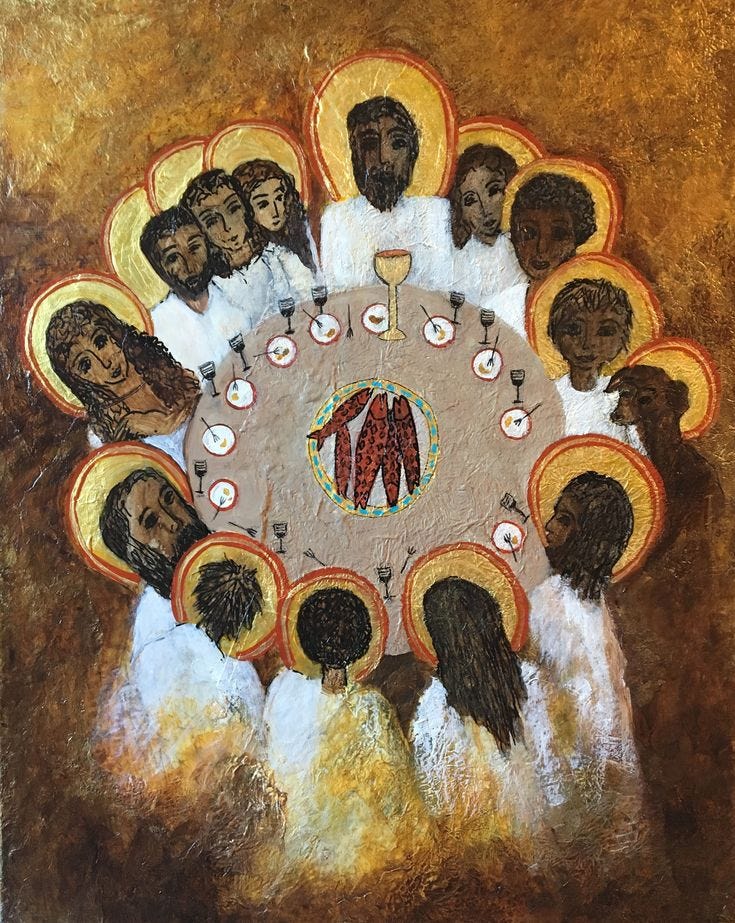
How are we being responsive to the people God loves? What are you communicating with the people you surround yourself with and the conversations you join? Are you willing to make space when it is inconvenient? Are you willing to include others when the world tells you to ostracize? Does your life tell of a God that invites anyone who is willing to come and feast at the table in His kingdom?
Go out at once into the streets and lanes of the town and bring in the poor, the crippled, the blind, and the lame… Go out into the roads and lanes, and compel people to come in, so that my house may be filled.
Luke 14:21–23 NRSV
Are you with your words and actions inviting everyone to come and fill the seats at Christ’s table?
Are you making space?
Put your legs down in front of you. Set your bag by your feet. Scoot over, and welcome each person into the love of God.
Love well. Love deep. Love wide. Love past your fears and the lies you’ve believed about people. Listen. Understand. Be a witness to their stories. Make space for God to move in and through you, maybe even in spite of you.
Without a question, an answer is experienced as manipulation or control.
Without a struggle, the help offered is considered interference.
And without the desire to learn, direction is easily felt as oppression.
Henri Nouwen
May Christ move in each of our hearts, that our welcome might echo His as we invite our neighbors into the kingdom
.
Such a beautiful post, Audrey. ❤️
Wow! This was a beautiful reminder of who our neighbor is. The subway picture is one I easily resonate with. Thank you Audrey. Your writing blesses me.